
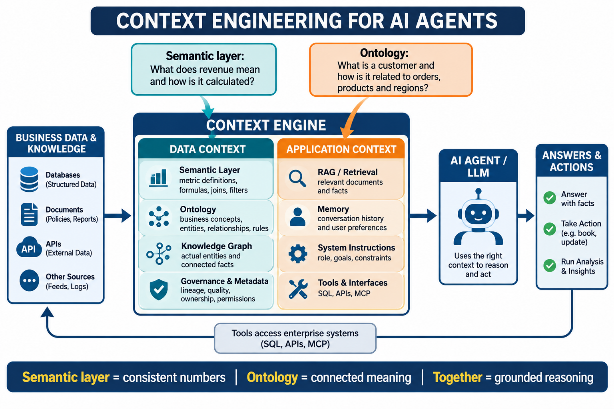
Lately, I’ve noticed that terms describing how AI agents access and use information are being thrown around quite loosely. Concepts like Context Engineering, Semantic Layers, Ontologies, Knowledge Graphs and Metadata Repositories are often used interchangeably, even though each has a different purpose and role to play.
So, this week, I decided to dig a little deeper into these concepts — what they actually mean, how they differ, and how they all come together to give AI agents the context and knowledge they need to understand information, reason, and take action.
Python dominated AI programming for years. But in 2026, Rust seems to be gaining ground as the infrastructure language of AI. Rust has the potential to be the default programming language for the AI backbone. It can move the complexity to compiler so the failures are caught early and not at run-time where fixing them is much more expensive. Basically, the compiler will act as a co-pilot for building AI infrastructure.
Always- on agents are really coming of age – latest LLM models and infrastructure are converging to make the agents less expensive and more accurate. This article from Claude explained the basics of always-on agents very well.